
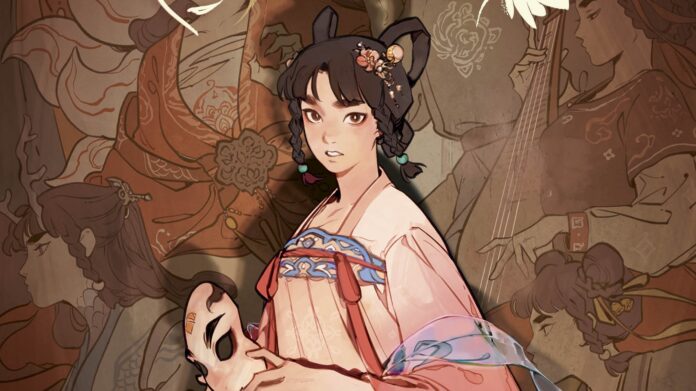
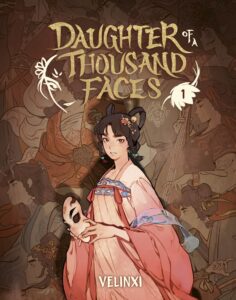
 Daughter of a Thousand Faces by Velinxi is an Eisner and Ringo Award-nominated vertical scrolling comic with over 2 million views on Tapas, and it’s finally available in print from Inklore! The comic is available in both paperback and hardcover, and Volume 1 compiles the first 20 chapters.
Besides her original works, Daughter of a Thousand Faces and Countdown to Countdown, she’s also known for her illustrations for the fan-favorite danmei The Scum Villain’s Self-Saving System, available in English from Seven Seas Entertainment. K-Comics Beat chatted with Velinxi about her inspirations, the challenges of creating a new work within an established genre, the themes she explores in Daughter of a Thousand Faces, the process of the book’s print release, and her first live drawing and Q&A with fans during this year’s Anime NYC!
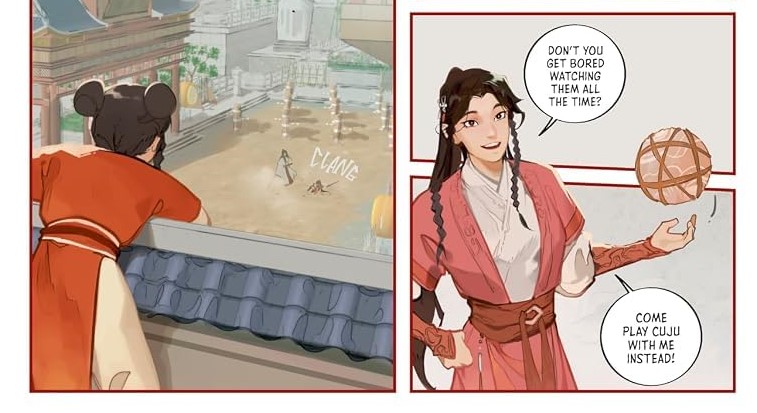
Daughter of a Thousand Faces tells the story of a disgraced daughter Shen Yuhua, who neither inherited her father’s powers nor managed to land a prospective marriage. Losing her last pillar of support and with no more than a servant on her side, Shen Yuhua leaps into the abyss and meets a demon that’ll change the course of her story.
During the preparation of this interview, the English comics market was hit with the news of Tapas’ shutting down. You can read Velinxi’s personal thoughts and on the future of Daughter of a Thousand Faces here.
The beginnings
MERVE GIRAY: Could you briefly introduce yourself to our readers? What are three non-webtoon related things in your life that gives shape to or heavily inspires your creative process, specifically Daughter of a Thousand Faces?
VELINXI: Hey, I’m Velinxi! I’m a webcomic artist, illustrator, and fanartist. These are all pretty connected to one another. When I’m not working, I’m a part-time D&D player/dungeon master, avid fantasy reader, and horse girl. These three things also somehow feed back into my webcomics, funnily enough.
GIRAY: What was the spark, or starting point of Daughter of a Thousand Faces? The xianxia genre has taken root in the English-language comics and novel market, more recently popularized by danmei. What made you gravitate towards the genre when you were first giving shape to this series?
VELINXI: I definitely also gravitated to making Daughter of a Thousand Faces from danmei! Growing up, I was always in love with dramas/films like Journey to the West and Return of the Condor Heroes, but the boom in Chinese fantasy in the English-language market pulled me back in. MXTX‘s works were kind of patient zero for me, which I’m sure is unsurprising given how many people know me from my artwork for the The Scum Villain’s Self-Saving System English books.
As a matter of fact, Daughter of a Thousand Faces was initially supposed to be a danmei, with Swallowtail as the protagonist. The story changed drastically at some point, obviously. Afterwards, Daughter of a Thousand Faces just began to form based on my inspirations and the itches I wanted to scratch in telling a story.
GIRAY: Do you find working within a well-known and explored genre with rich history to be more freeing? Or restricting? Did you ever feel like you had to adhere to certain depictions, elements etc.?
VELINXI: It’s definitely a mix of both. I’ve found that when it comes to fantasy steeped in an existing culture, there’s a lot of things you want to keep in mind to avoid any disrespect or cultural inaccuracies. There will always be stretches, and inaccuracies will always be inevitable, of course. We’re always throwing the characters into a bunch of clothes from all sorts of different dynasties, ages, dresses that never even existed, etc. It’s a fantasy, after all! But I’ve found that toeing that line can be a careful balancing act. There are just so many things one must keep in mind, so many details from the beliefs that xianxia/wuxia draw from that must be respected—names, kowtowing, phrases, addresses, hierarchies, etc. And even then, there will always be unsatisfied readers, even when the stories are written by people of that specific culture. That’s perfectly alright, though, so long as any portrayals never step into offensive or disrespectful territory. Everyone is entitled to their own opinions on how this genre should be written.
There is definitely something freeing in drawing Daughter of a Thousand Faces, though. I’ve never had so much fun drawing so much beautiful, flowing fabric and dashing sword fighters.
Daughters, masks, and fitting in
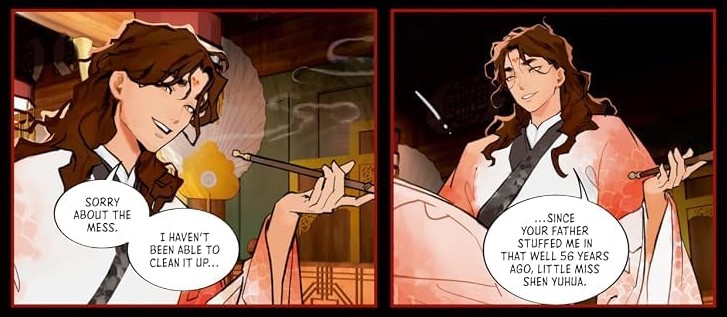
GIRAY: The story opens with Shen Yuhua losing her mother twice: both her physical presence and her warm support in a family and a system that doesn’t acknowledge her. Not to mention you dedicate the volume to your mother. However, only through a self-serving desire to survive and demand for respect does she pique the interest of Chu Tian, the demon that dwells in the abyss. This may be a loaded question, but what is the significance of family, bonds, and individual strength for you? Could be to you as an artist, or within the context of this work.
VELINXI: Very loaded! But it’s a very welcome and thought-provoking question for me. I could talk all day about growing up with a complicated family dynamic, but that’s just me among every other person on the planet, isn’t it? The themes I’ve written about in Daughter of a Thousand Faces—neglect, abandonment, feeling unseen by your family, needing to rely on yourself from a young age—are things I think we can all relate to. Some feel it more sharply than others, probably, but we’re all human and avoiding such feelings is kind of impossible. So I’ll focus on the significance of these themes in the context of Daughter of a Thousand Faces.
I don’t think anyone is surprised to hear that family, bonds, and individual strength are important staples to the xianxia genre, given how important and emphasized these are in Chinese beliefs. Being able to rise above your station through your own wits and strength is a tale told time and time again. It’s a very noble and inspiring concept. But sometimes I do wonder about the darker implications of such an idea, especially when it’s applied to young protagonists that have no other choice but to rely on themselves. Where are their support systems? Why must they do this alone? What kind of environment are they in where they must do this in the first place? And is where they end up really worth all the bloodshed and sacrifice? This was my main idea for Yuhua. In a cold environment where family seems to be everything, she has been stripped of that and is left to cling onto what remains: a suspect manservant, a stalker from another sect, and a demon. It’s definitely a play on the found family trope, but again, a more pessimistic approach to it. These are all important aspects to Yuhua’s character, along with her foil in Season 2, Qiao Yu. They’re what makes my characters them, I suppose.
GIRAY: Metaphorically speaking, wearing masks and assuming others’ appearances can be both an excellent talent used to fit in and a curse that hinders the ability to see one’s self. Only by facing others as who we are can we form a sense of self. It seems all the more significant considering the protagonist having trouble fitting into established roles and expectations. What made you choose such a power for Chu Tian and have him teach such a technique to Shen Yuhua?
VELINXI: First off, a great observation! Chu Tian was first designed around the art of Bian Lian, a Sichuan Opera technique where performers are able to change their masks in a split second (if you’ve never seen this, I highly recommend searching some clips up, it’s seriously so cool). The deeper ideas and themes around face-changing in the context of the story were developed after.
Chu Tian himself is supposed to be a deeply mysterious character. He’s old, always doing off doing his own thing, only cares for himself, and is constantly lying to everyone. By season 2, he’s even lying to himself. His power is a reflection of himself as a person, in a way. By teaching it to Yuhua, I imagine there’s a slight parallel to how a parent ends up teaching a terrible habit to their child. Yes, he’s hardening her this way, making her stronger, but it’s definitely not healthy for her given how it deteriorates her mentally. Yuhua ends up embracing her new powers in a way, pulling away from reality and friends, because like Chu Tian, she’s also lying to herself and unable to face her past or present. They’re in a terrible little cycle.
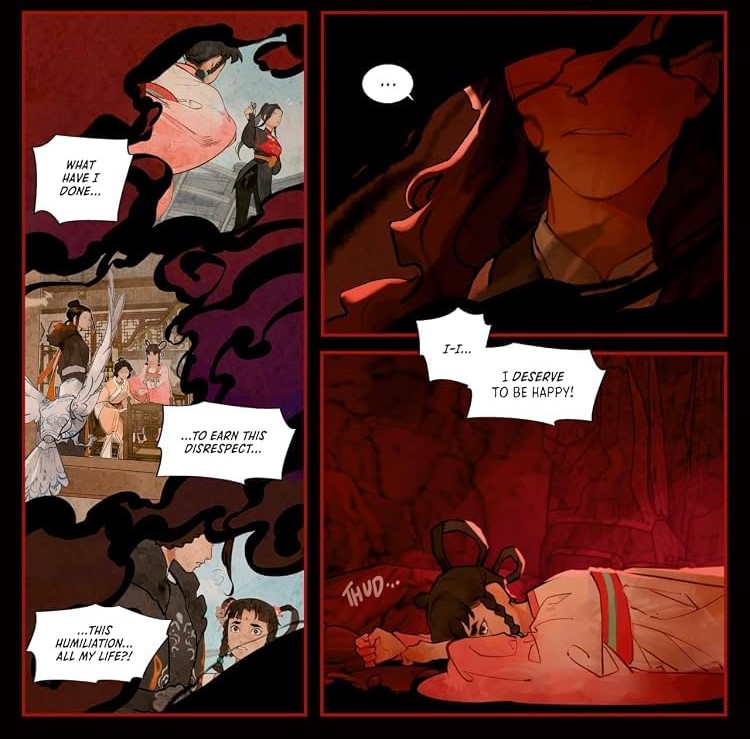
GIRAY: Contrary to the rather heavy topics you delve into, the tone is quite light and the scenes are often cut into with comedic depictions or lines. Is the lighthearted tone intentional to ease the reader into the story? Or as an artist, do you tend to gravitate towards humor?
VELINXI: I definitely gravitate towards humor, but the light tone in season 1 is definitely intentional! It’s still how Yuhua views the world. Despite her terrible upbringing, she’s still got the snark of a somewhat sheltered teenager. It’s part keeping the story light when it’s still somewhat light, and part Yuhua coping. It definitely falls to the back end a bit in season 2, however, as Yuhua’s mental state worsens.
GIRAY: Daughter of a Thousand Faces is heavy on the exposition as well. We often read big chunks of texts, and some take half the page, which reminded me of traditional Chinese pieces that combined text/poetry and images. Was this intentional on your part, or did you simply want to convey the complex structure of the fictional world through text rather than explicitly drawing it all?
VELINXI: I wish I could attribute the text to such a beautiful idea! But no, this was part of an experiment I was working on back when I was pitching this to Tapas in 2020-2021. It was supposed to be more text-heavy back then, more storybook-like rather than leaning much more into comic territory. Now, I use text to focus more on Yuhua’s feelings and her interpretation/exposition of the world around her.
GIRAY: The line weight, the texture and the coloring/shading that is reminiscent of ink on paper fits the setting, which also provides fluidity that serves the fantasy genre and the vertical format of webtoons. Comparatively, your other series Countdown to Countdown is in page comic format and adheres to a more rigid paneling. What are the pros and cons to these formats? Which do you find easier/fun to work with? Also, webtoons tend to stick to a rigorous schedule. What kind of experience is it for you to work around such a schedule?
VELINXI: Both formats definitely have their pros and cons! I find that the vertical format makes pacing so much easier, as you can add pauses and vastly change the size of panels to convey a sense of urgency or dwell on small pauses. The long canvases one has to work on can be a pain, though, especially since I’m married to good old Paint Tool Sai. The traditional comic paneling can be boring at times, especially when you’re no Kamome Shirahama, and the need to fit everything into a specific canvas size with a set amount of pages can be stifling. On the flip side, though, limitations can breed creativity, and I find myself having the most fun when I play with fourth-wall breaking and non-traditional panels.
Releasing whole episodes on a set schedule can be rough, but Tapas was very supportive and understanding of me, luckily. I had a team of helpers and we made sure there was a long buffer and hiatuses to make sure I could write and draw in a reasonable manner. It was a huge relief, especially after hearing so many horror stories online. That’s not to say it still isn’t strict, though, especially since I balance it with another webcomic and freelance projects! I work everyday from 10 to 11 and make sure I have a set schedule to make my deadlines, and I wouldn’t trade this job for anything else.
On going print and meeting fans
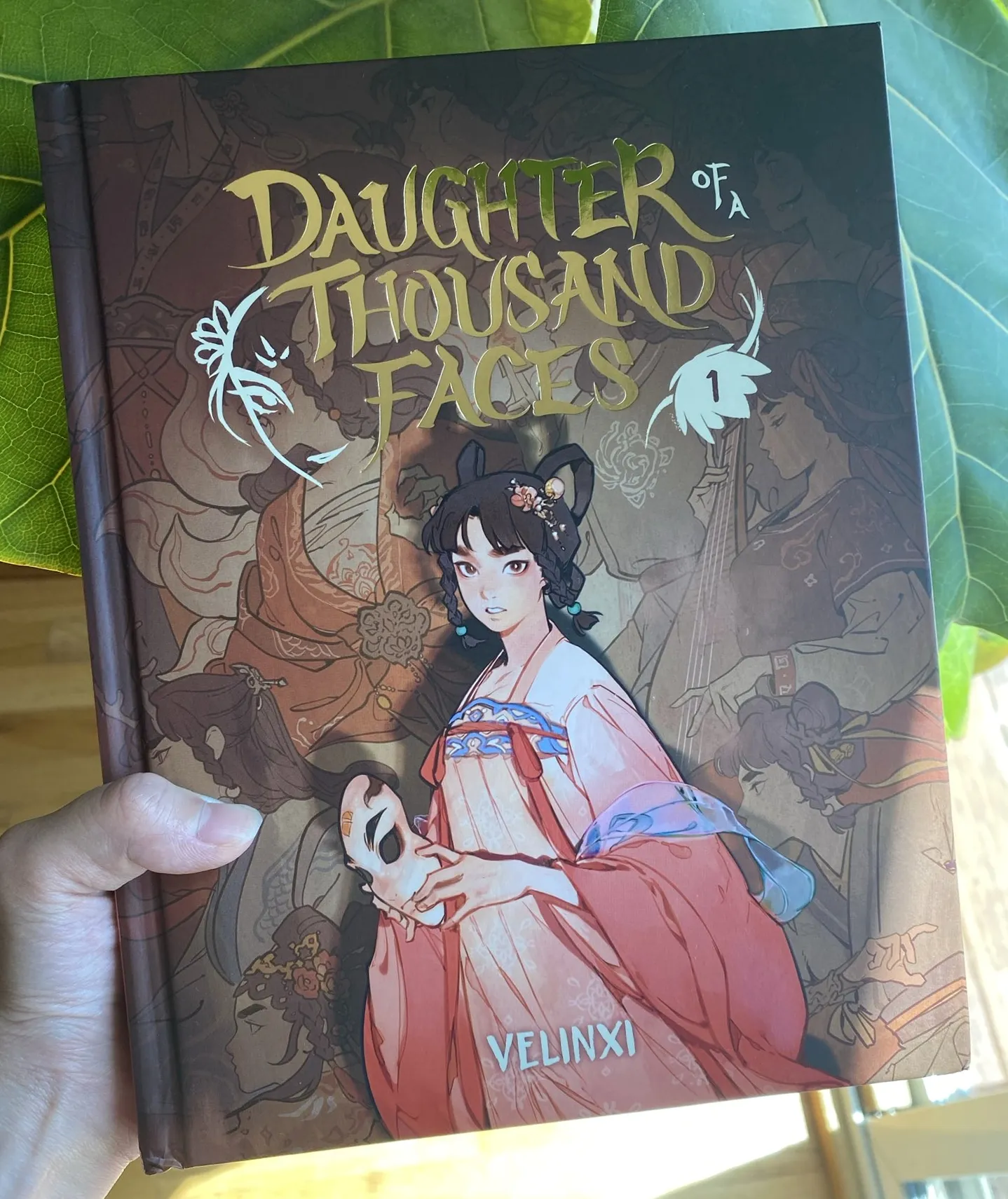
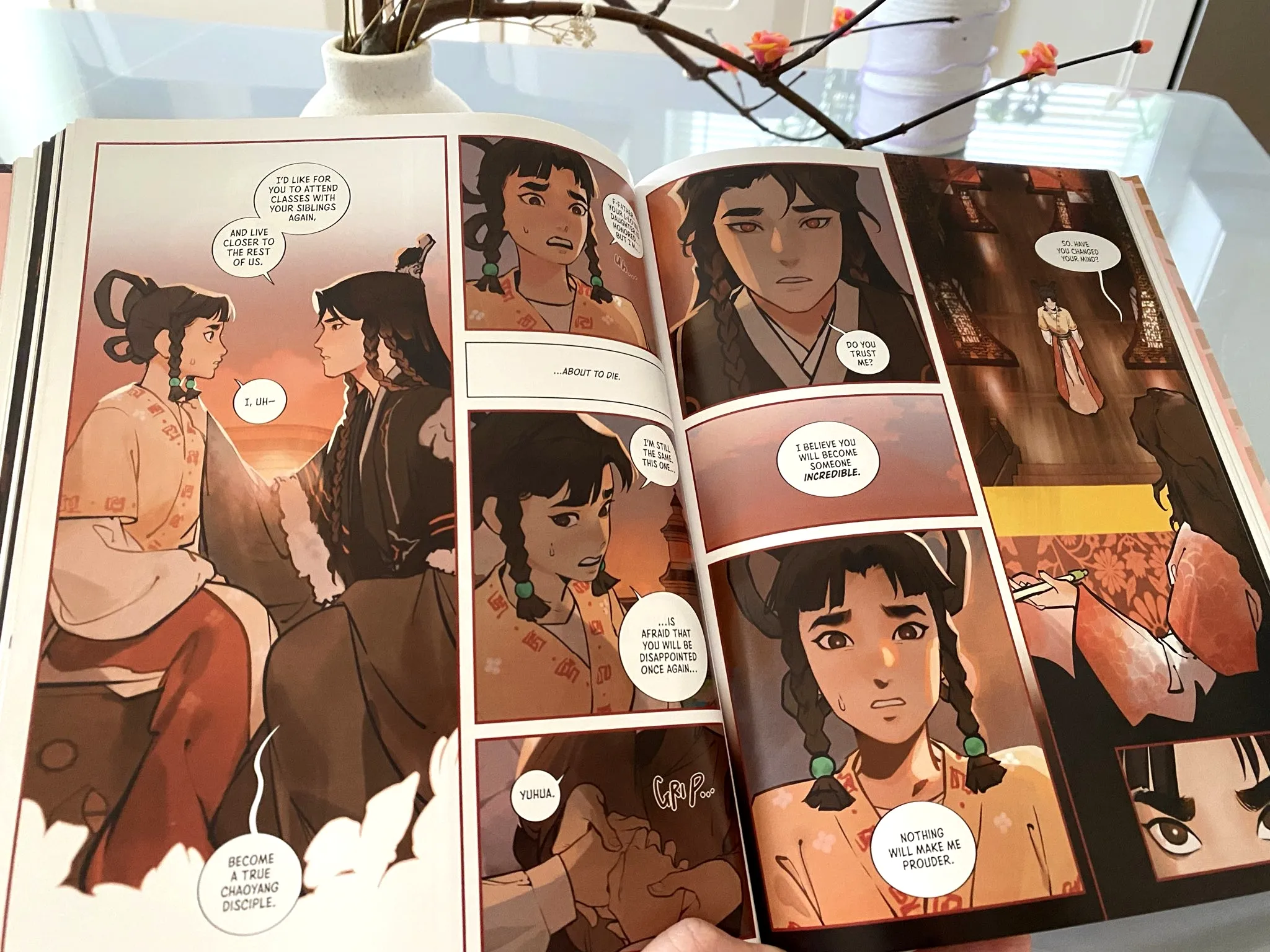
GIRAY: Congratulations on your partnership with Inklore! Currently, fan-favorite webtoons are adapted into page comic format frequently. Were you involved in the process in any way? Or was the adaptation done by a team on Inklore’s side?
VELINXI: Thank you! I’m still so honored and consider myself very lucky to work with Inklore. I’m so happy to see the power of fandom being seen and rewarded, for myself and so many other creators. The reformats were all done by Inklore, I only stepped in here and there with some notes and suggestions afterwards. There were really barely any notes on my part, just nitpicks with pacing and sound effects. The team has done an incredible job with translating the scrolling format into traditionally printed pages.
GIRAY: How do you think your comic translated from one format to another? I’m sure all your hard work brought to life as a tangible object must be exciting on its own, but what worked in favor of and against Daughter of a Thousand Faces when translated into a new format?
VELINXI: It was soooo exciting. My mother screamed in delight, and my father even gave me a solid nod before posting a picture of it to his WeChat friends. There’s definitely something so beautiful about seeing years of my work compiled into a single book and printed so beautifully. It was rough having some of the pauses I added in the scrolling format be condensed. I definitely requested some shifting in panels to better help the pacing, but I still think some of it was lost in the reformat.
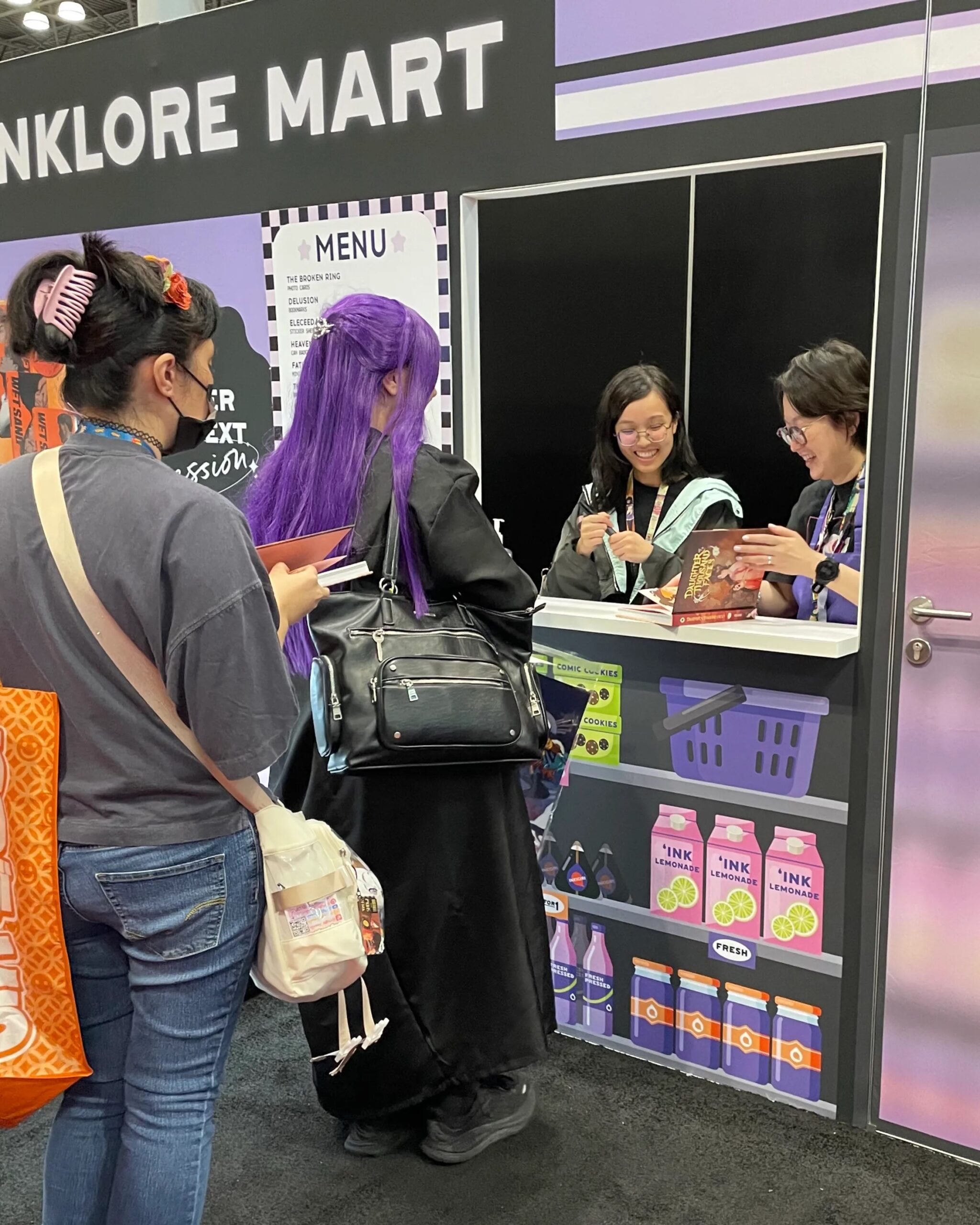
GIRAY: I’d also like to congratulate you on your Anime NYC live drawing and Q&A session! Creating is often a solitary process, even when you receive technical support for coloring/backgrounds or work with an editor. You have a presence on social media and Tapas’ comment section provides quick interaction, but through a screen. How was it for you to go from tabling at Anime NYC to finally go up on the stage? How does it feel to meet such a crowd face to face? How was the energy?
VELINXI: Thank you, it’s one of my favorite ANYC memories ever, and I’ve been there every year since 2018! It’s always strange to meet fans in person; there’s always some part of me that can’t comprehend that there are real people who support my work. Going up on stage for a panel with a room full of people who support me was so nerve-wracking and surreal. It ended up going great, though! It felt like I was talking to a room full of friends, and there was so much laughter and inside jokes. I couldn’t be more grateful. I think a lot of my supporters are also fellow artists and/or part of the queer community, so there are just so many moments where I feel like they “get me”.
GIRAY: Can you share one or two memorable moments? Sometimes careful readers catch things in a work that the artist themselves aren’t aware of. Did anyone surprise you in that way?
VELINXI: For the panel? I’ll let you in on something. When I arrived to the panel room 10 minutes before it started, I was so nervous. I’d never done a solo panel, I hadn’t slept a single hour the night before. I was so sure no one would show up. Added to that it was like, a pretty big room with so many chairs. I rushed to the bathroom to collect myself, telling myself it was okay no matter what happened. Then I worried for nothing, because it turns out all my fans just like to procrastinate, like me. Everyone filled in like right on time, and I finally stopped internally crashing out. The moment when I got on stage and said hello to everyone and everyone answered back, I recognized so many faces from people that had swung by prior to my artist alley table… I really don’t think I can forget that.
This happens a lot! I’ve had so many interesting theories and comments on all of my comics. For Countdown to Countdown, there’s an entire channel in the CTC discord dedicated to theory-crafting and pointing out small details. I think I have a lot of smart readers. And sometimes it’s very annoying, because I’m not nearly that smart. Too many times have I read a comment that made me slam a hand on the table, going “Damn it! Why didn’t I think of that?”
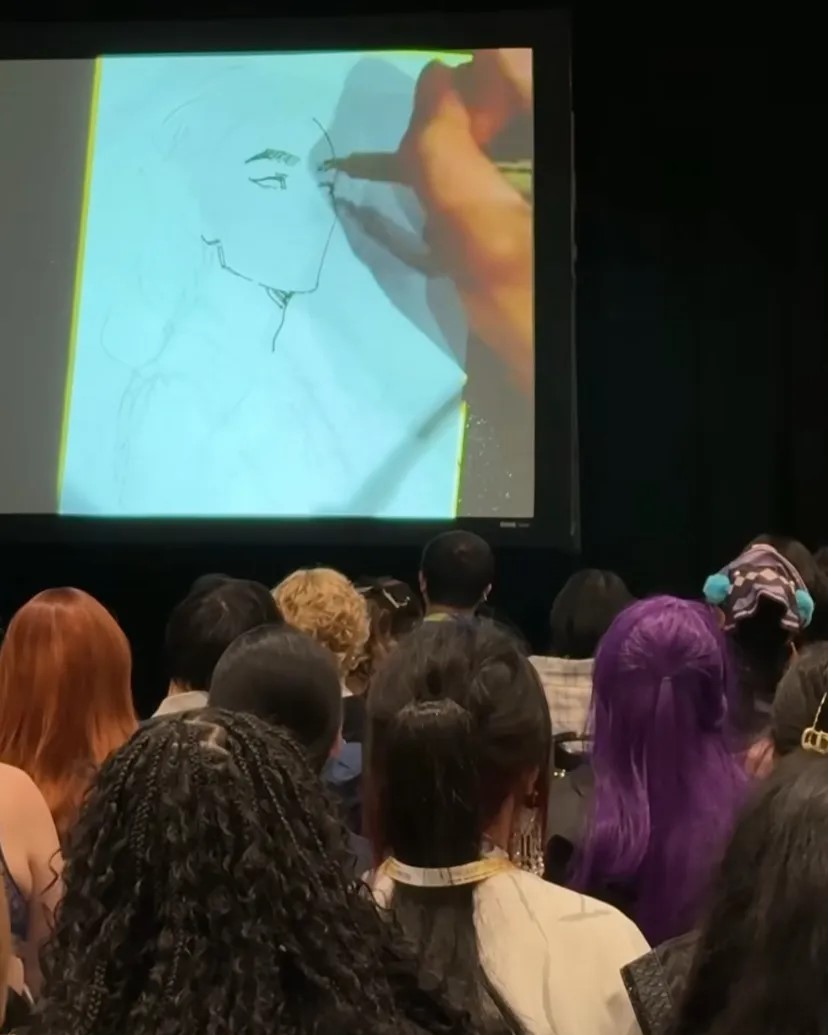
Velinxi’s Anime NYC 2026 attendance and live drawing session, taken from the artist’s Bluesky account

