

 To the Last Gram
Written by: Shreya Davies
Illustrated by: Vanessa Wong
Lettered by: May Thu
Edited by: Adan Jimenez
Published by: Difference Engine
Publication Date: May 12
Content Warnings: To the Last Gram and this review frankly discuss eating disorders, depression, and associated physical and non-physical symptoms of these conditions, as well as self-harm.
The first time Divya Joshi learns she’s fat, it’s in a gymnastics class when she’s just 6 years old. “Fat people can’t do gymnastics,” one of her peers declares, and Divya internalizes both this “fact” and the feeling that she doesn’t belong.
Her body isn’t the only thing that makes Divya different. At home, her mom painstakingly makes breakfast, lunch, and dinner for their family, which they eat together using their hands. Meanwhile, Divya’s friends seem to rarely eat home-cooked meals, and they always use utensils. Most of her friends also boast straight hair. In an attempt to fit in, Divya agrees to meals with her friends even if she’s already eaten and even begs her mother for a salon appointment to relax her curls.
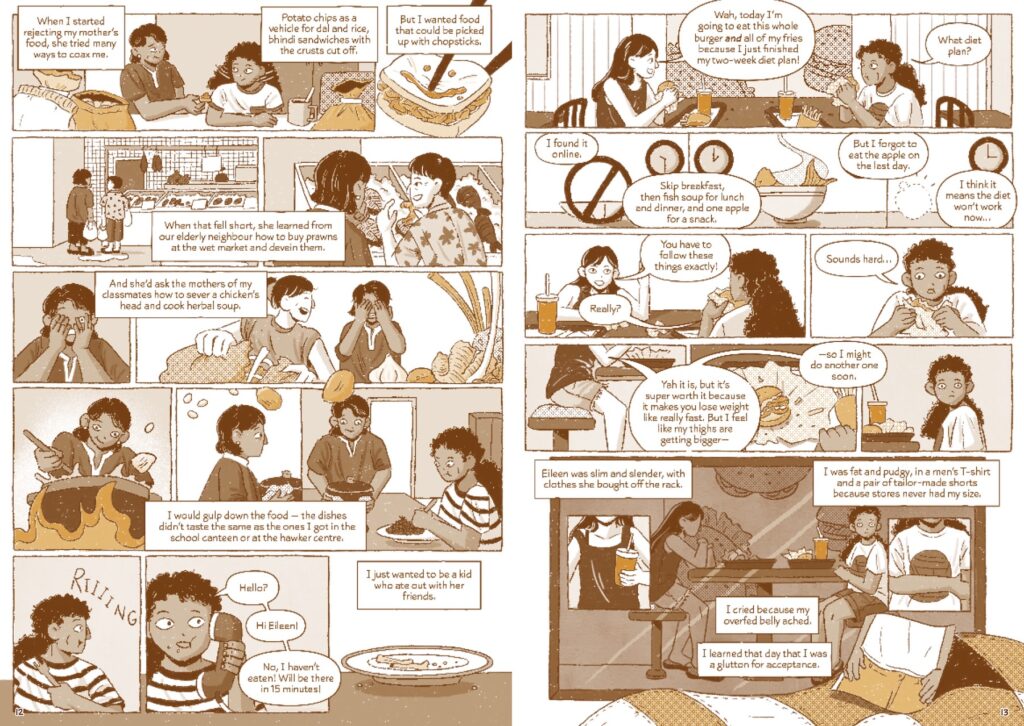
But as Divya gets older, the gap separating her from her peers grows wider. Most notably, her friends start talking about dieting and exercise when they are incredibly young, which makes Divya feel terrible for not just what she eats, but how much and how often. Then her school sends home a referral to an obesity clinic, which tells Divya and her parents that she needs to lose weight. Once Divya starts dieting, she can’t stop—eventually developing anorexia and an exercise addiction, as well as a binging cycle.
To the Last Gram explores Divya’s world through her POV as she navigates a serious eating disorder and the physical and psychological symptoms that accompany it. Although she claims to feel empowered and good about how much weight she loses initially, the feeling doesn’t last as her body slowly begins to shut down.
Divya’s restriction impacts her menstrual cycle, causing her to self-harm, and makes it impossible for her to maintain the friendships she so desperately craves at the beginning of the story because she becomes so focused on restricting and exercising. As her body shrinks, so does her life, until she becomes so worried for herself that she asks her parents for help.
Of course, the road to recovery isn’t linear. Divya faces more than one pitfall and struggles not to fall into old habits, finding new ways to be obsessed with her weight and the number on the scale. She also struggles with severe depression, which presents new obstacles. With support, she eventually figures out how to listen to her body and truly give it what it needs, rather than what her illness makes her believe is best. The most important facet of her recovery is time, which she gets better at accepting the older she gets.
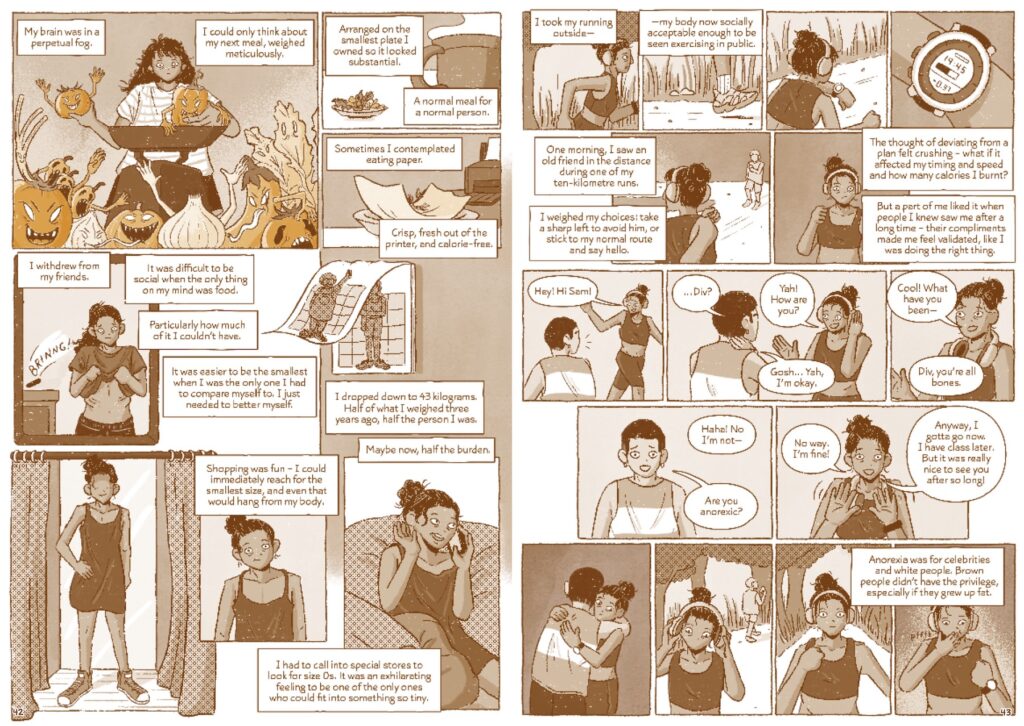
To the Last Gram is a fraught read, in that doesn’t shy away from the intensity of anorexia or the danger it poses. It presents Divya’s single-minded obsession with thinness for what it is: an illness with sociological factors perpetuated by systemic anti-fatness and racism. The latter is most acutely present in the scene at the obesity clinic, when the physician who tells Divya to diet keeps mentioning how much fat is in Indian food—effectively blaming not just Divya’s parents for her size, but their entire culture.
This isn’t a recovery story, per se; there’s no moment of salvation or catharsis here, and there doesn’t need to be. Writer Shreya Davies and artist Vanessa Wong successfully craft a narrative about what it’s like to live with an eating disorder, from which many people don’t ever recover. Attempts by her family to intervene before Divya is ready to accept her condition are met with defensiveness and anger. Despite how she fights, when Divya eventually acknowledges how sick she is and how heavily she’s flirting with death, she seeks help from her family and finds it, which is not the case for everyone.
In that way, To the Last Gram is also a very hopeful read. Divya positions herself as a patchwork quilt in the opening, then revisits the image only a handful of times before the final page, recounting how all of her experiences—good, bad, and ugly—make her who she is. This metaphor works solely as a framing device, which gives it some punch when it reappears. A patchwork quilt isn’t perfect, and neither is Divya. It isn’t “fixed,” and neither is she. This is a major takeaway from the book, and it’s important to the way we talk about eating disorders. Recovery is possible, but it’s almost never easy, and it often takes a long, long time. Much like trauma, it has to be carried, and it’s weight may shift over the years.
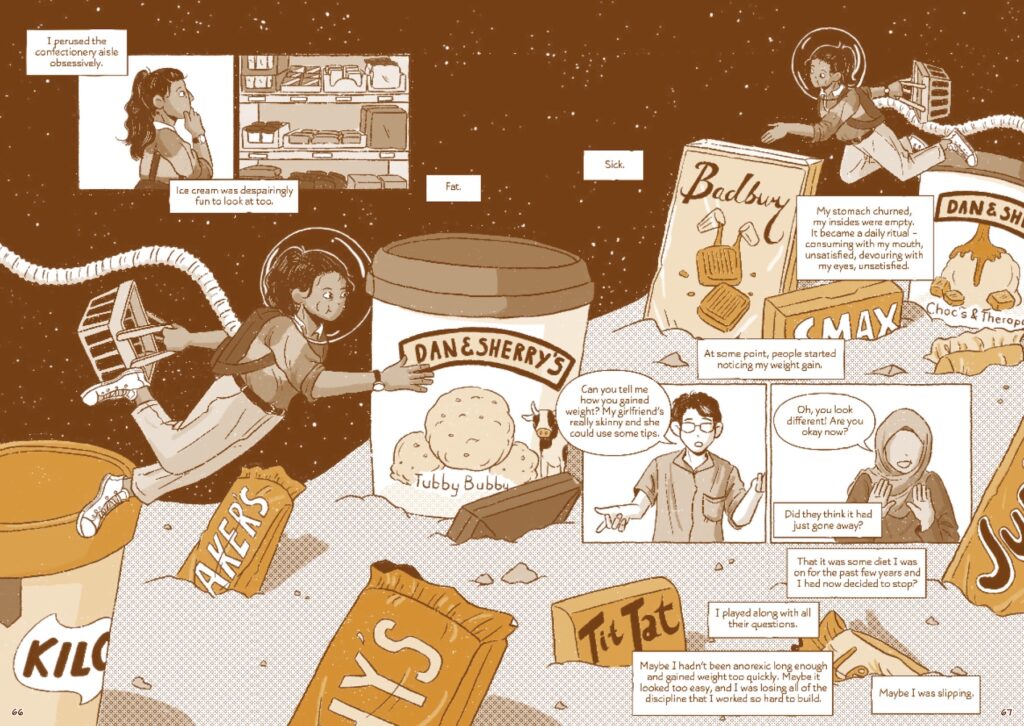
Davies’s writing throughout To the Last Gram is super sharp, incorporating information about outside forces that can lead someone to develop an eating disorder—anti-fatness, diet culture, racism—as well as dialogue that acknowledges how many people in Divya’s life knew she was sick, but didn’t necessarily know how to talk to her about it. Divya’s inner monologue rarely pauses, even when she’s dealing with significant brain fog, demonstrating how completely her obsession with her weight has taken over.
Wong’s kinetic illustrations and monochrome color palette spotlight Divya’s development of and dedication to routine, with traditional panels showcasing her day-to-day. Then, Wong spins up splashy, chaotic full-page panels and two-page spreads that indicate how hard Divya is crashing internally, with smaller panels operating as anchors when she makes decisions.
Together, Davies and Wong create a visual marvel that tackles a devastating topic with the utmost care. Letterer and designer May Thu does an incredible job tying everything together, for one of the most captivating, character-driven comics to debut this year.
Final Verdict: Buy

