
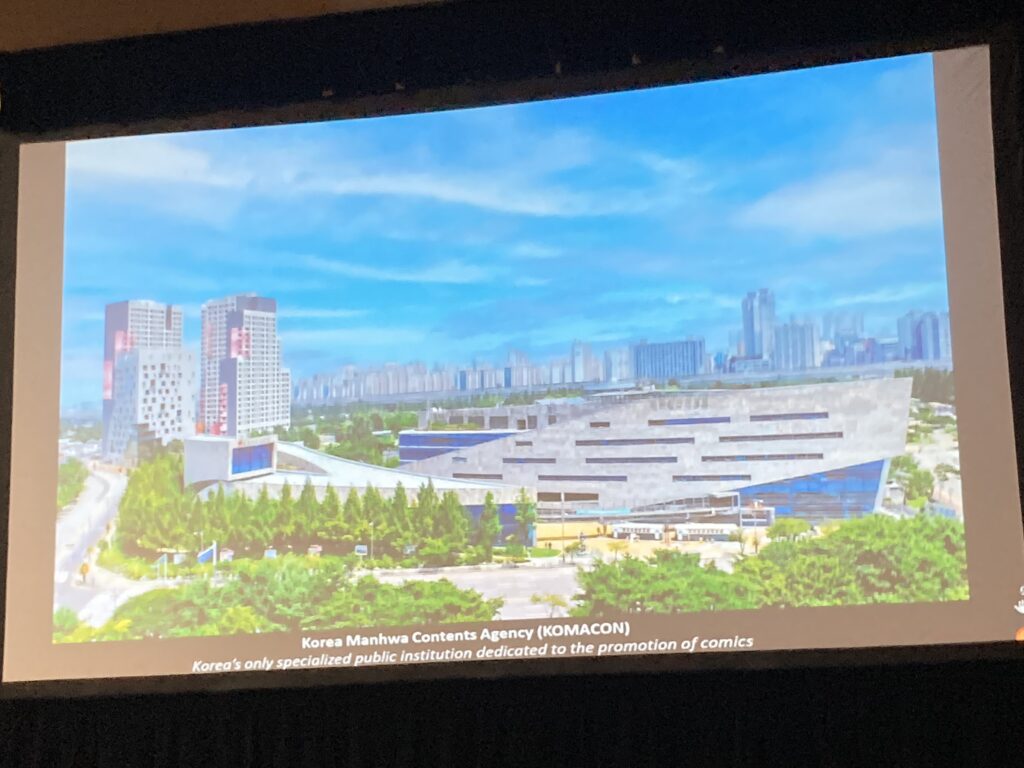
Despite WEBTOON’s popularity abroad, very little information about the history of manhwa is available in English. That’s why it matters that Korea Manhwa Contents Agency, or KOMACON, visited Otakon this year in 2026. KOMACON manages various institutions including the Korea Manhwa Museum, the yearly Bucheon International Comics Festival, and others. They run Today’s Our Manhwa Award as well as the Bucheon Comics Award. Additionally, they preserve Korean manhwa, particularly early titles from the print generation.
As part of the panel “Manhwa and Korea’s National Registered Cultural Heritage,” KOMACON curator Choi Eun Young introduced the audience to four early manhwa series that have been recognized by the Korean government as national heritage works. Each occupies a specific role in the country’s literature, whether as political cartoons, popular melodrama, or even a potential starting point for manhwa as a medium.
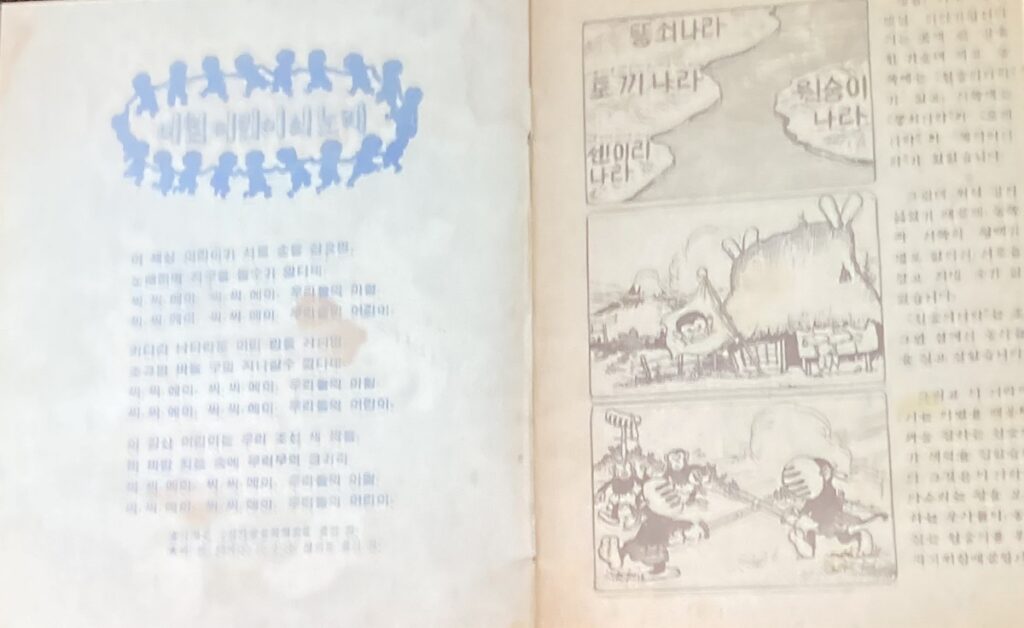
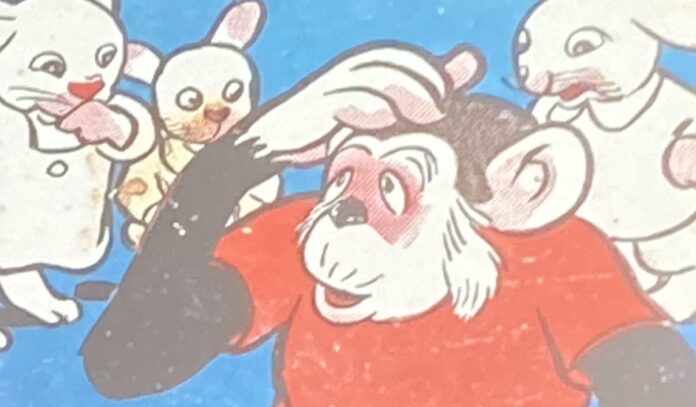
The Rabbit and the Monkey
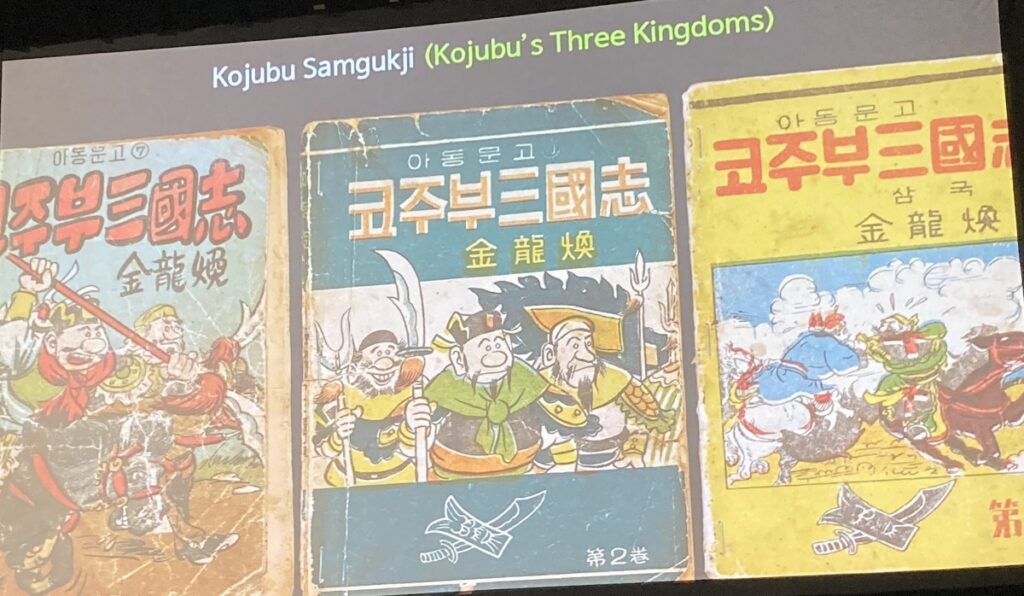
One of the most notable artists represented is Kim Yong-hwan, the former president of the Korea Cartoonists Association. According to Choi, Kim specialized in “fairy tale stories,” and created easily recognizable characters to convey his themes. His 1946 work The Rabbit and the Monkey, a societal satire, is the oldest existing manhwa volume. Later, in 1953, he adapted the classic Chinese historical novel Romance of the Three Kingdoms into the manhwa series Kojubu’s Three Kingdoms. Both The Rabbit and the Monkey and Kojubu’s Three Kingdoms are recognized as heritage works and held in KOMACON’s collection.
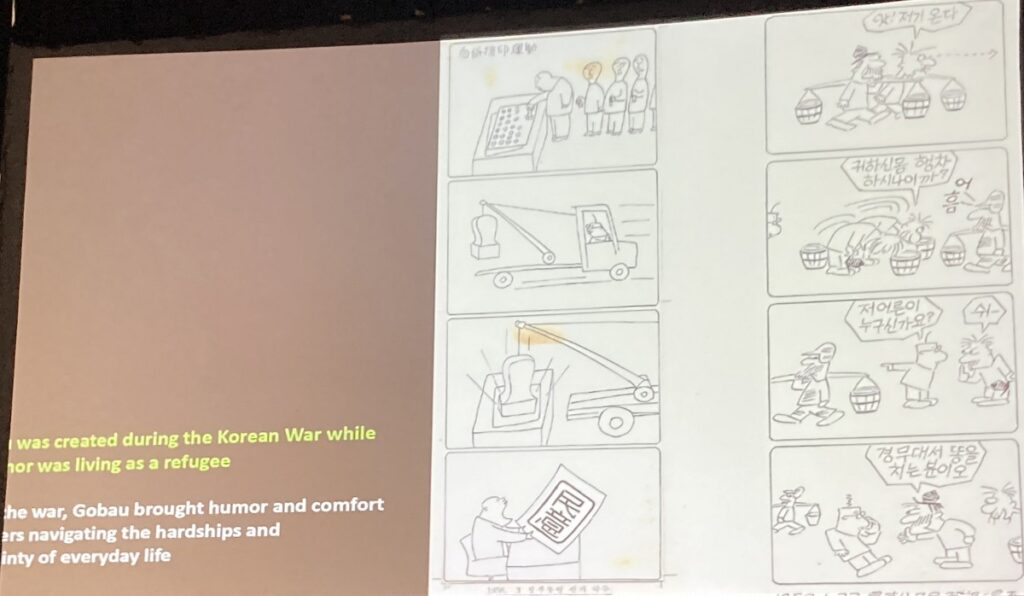
Another heritage work is Mr. Gobeau, Korea’s longest-running political cartoon. Originally serialized in newspapers beginning in 1955, the strip stars a simple drawing of a man with a single lock of hair that bends and straightens according to his emotions. Mr. Gobeau was drawn by Kim Seong-hwan, who is “regarded as the father of Korean editorial cartoons.” He was awarded a Gold Crown Order of Cultural Merit award by the Korean government in 2019. Original drawings from Mr. Gobeau are now held at the National Museum of Korean Contemporary History.
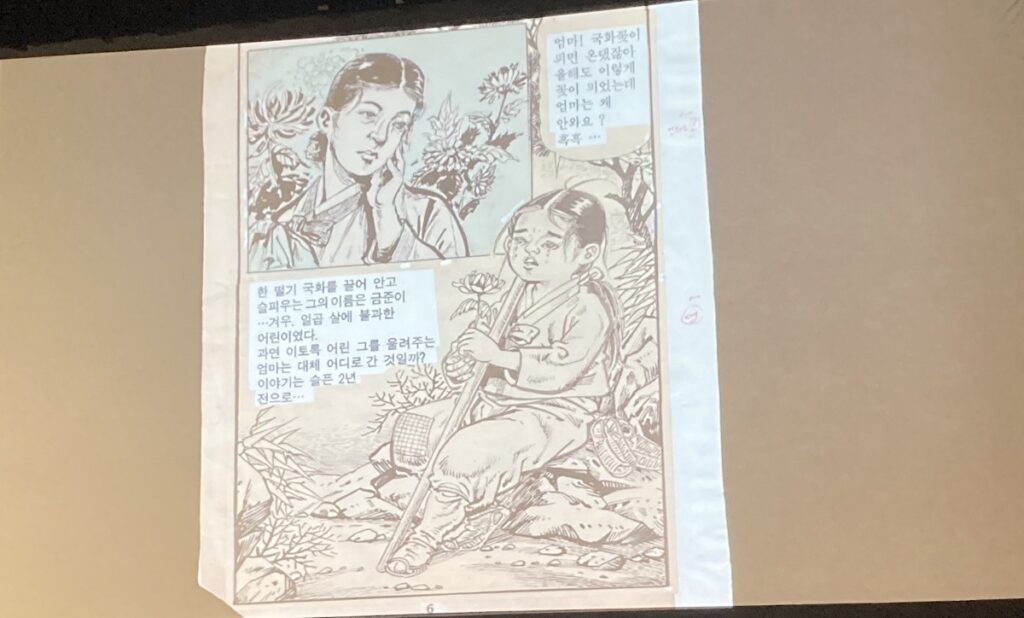
30,000 Ri in Search of Mother
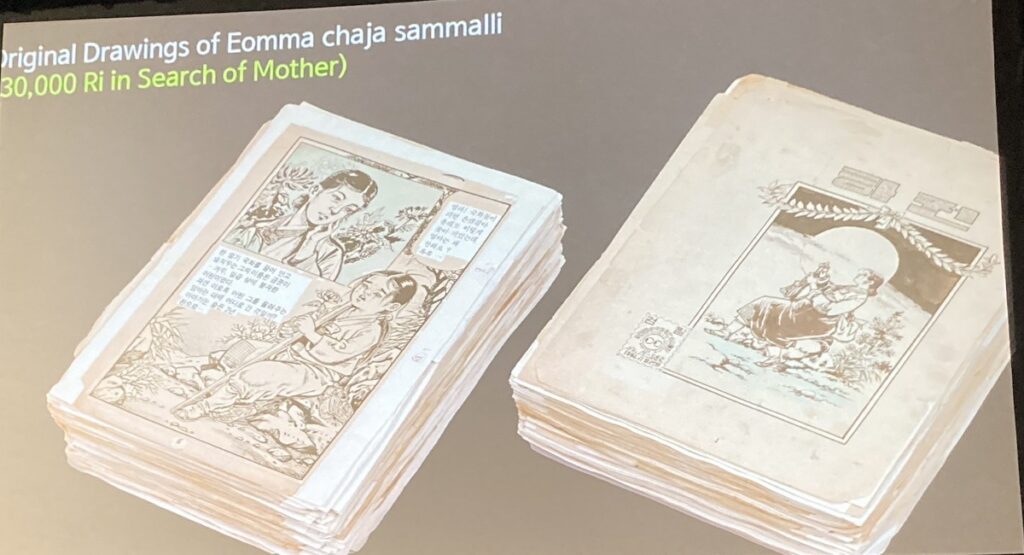
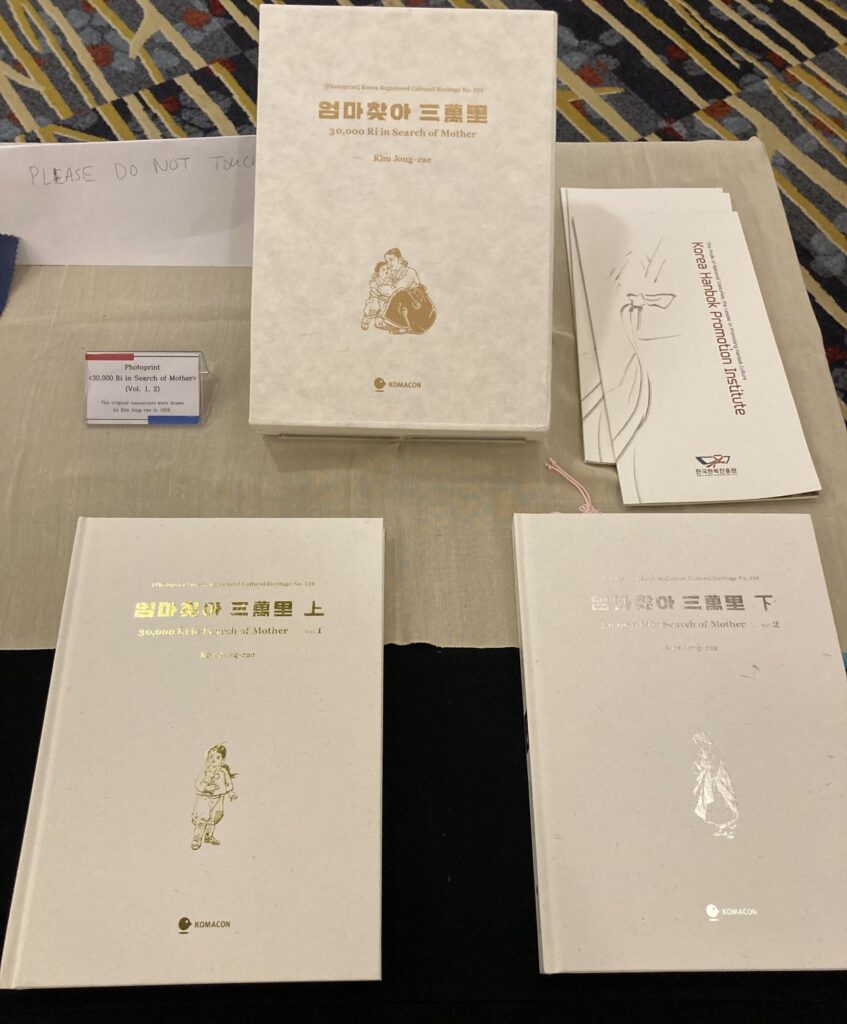
Last is 30,000 Ri in Search of Mother, Korea’s first bestselling comic—it sold through 10 consecutive printings. Set in the Joseon dynasty, the series follows a boy searching for his mother who has been sold into slavery. It was drawn by prolific manhwa artist Kim Jong-rae via traditional ink and brush; he would revise it four times between its initial 1954 publication and 1964. A hardbound copy representing the series was displayed at Otakon’s exhibit “Hanbok in Manhwa: Meeting Korean Culture Through Clothing.”
The age of these four works leads to certain limitations; as one member of the audience noted, all of them were drawn by men. “At the time, Korea was a patriarchal society,” said Choi, “so there were not many works by women.” (She went on to say that “many employees of KOMACON are women, so it’s something we have been thinking about.”) Additionally, since manhwa was once considered one of the “six major evils” by Korea’s government in the 1960s, there are some works with no existing physical copies even though they exist in the records. Others were lost entirely.
A matter of significance
At this time, KOMACON prioritizes the preservation of print rather than digital manhwa. When an audience member asked whether Solo Leveling might become a heritage work, Choi clarified that while the series was significant (particularly considering the webtoon artist DUBU’s untimely death) its status as a digital work complicated matters. “At this time, we do not have a system developed for original digital print creations,” she said. “But we will work on that.”
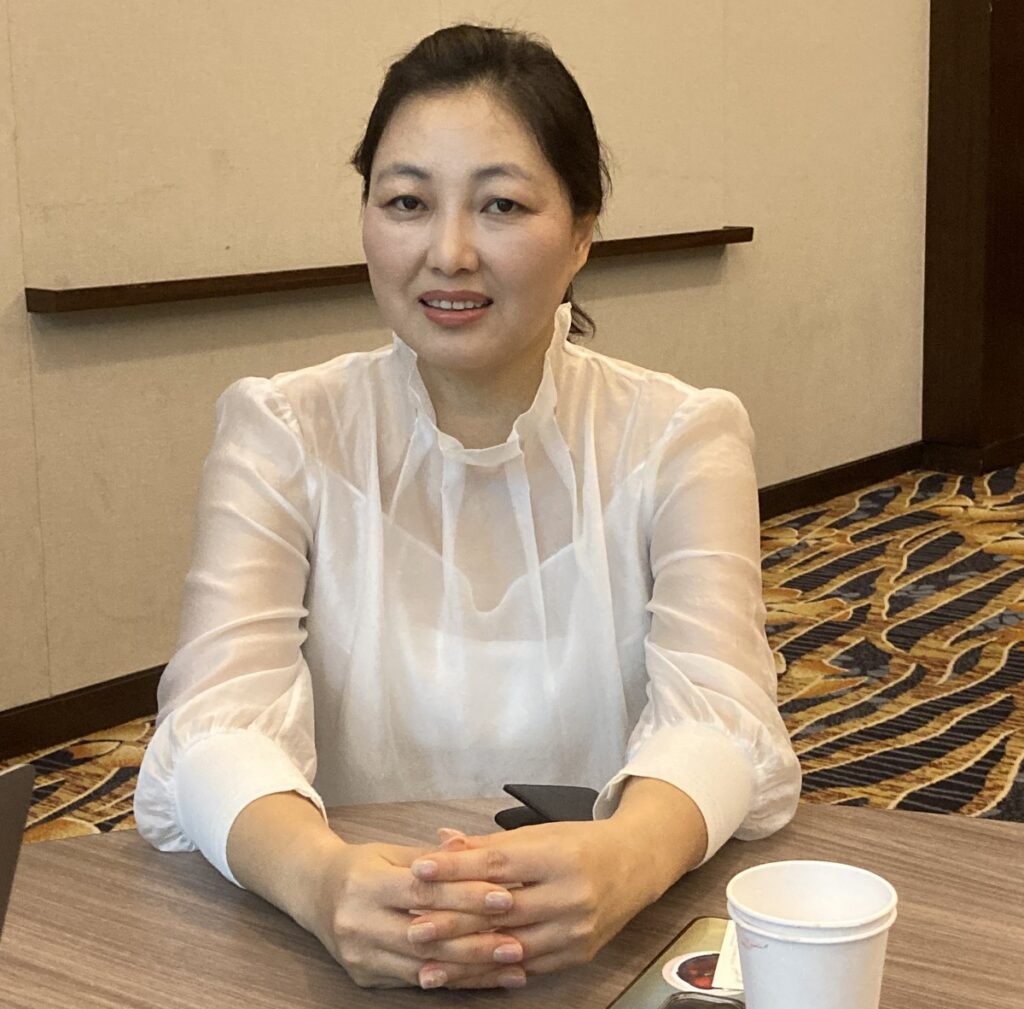
Comics Beat was fortunate to have the opportunity to speak with Can, one of KOMACON’s founding members as well as “the head of the library, museum and business center.” We discussed KOMACON’s various goals, the support it provides manhwa artists and assistants, and why so few winners of Today’s Our Manhwa Award have so far been translated into English.
This interview has been edited for clarity and content.
A liason between artists and the agency
WESCOTT: Please introduce your organization, yourself, and your purpose in visiting Otakon this year.
CAN: Hello! I am representing KOMACON, a manhwa promotion agency located in Bucheon, Korea. We are currently working on promotion, restoration and preservation of Korean manhwa, culture and history. We have been established for 27 years.
On our KOMACON campus, we have several facilities such as a library, a museum, a manhwa academy, a business center, as well as apartments for employees and authors to have residency. Our big event is our annual Bucheon International Comics Festival. Of those, I am the head of the library, museum and business center. I am also one of the founding members of KOMACON, so I have been with the organization for 27 years.
WESCOTT: Are you a manhwa artist yourself?
CAN: I am not. I work more as a liaison between artists and the agency. I study trends for popular manhwa, to see what materials are needed and what needs to be relayed between the two sides.
More sincere and human
WESCOTT: How has the Korean Manhwa Museum grown and changed since it was founded?
CAN: When the museum was founded, manhwa was a subculture, and the books were regarded as things you would read and throw away. There were not many print resources available. So KOMACON would go around making contacts with different authors. At the time when they still had manhwa rental stores, they would go to the biggest stores to find manhwa. Nowadays, they receive manhwa donations for the museum, so there is less legwork required.
KOMACON’s operations have varied significantly throughout its history. A lot of the current business comes from IP distribution rights for adaptations—dramas, movies, animation, things like that. I credit the growth in the industry to Covid-19, and post-Covid-19 to Netflix adapting many webtoons into live action. This has really pushed manhwa into something that is mainstream. Nowadays with the rise of AI models, manhwa feels more sincere and human. I’m looking forward to what the industry will become in the future.
Supporting their futures
WESCOTT: Does KOMACON support individual manhwa artists as well, aside from the industry as a whole?
CAN: Part of what KOMACON does through financial grants from the Korean government is to support manhwa creators within a contracted period, so that they can complete their work. Kim Jung Gi for instance was an attendee of Bucheon International Comics Festival, where he saw a live drawing that inspired him. Through KOMACON he was able to do dynamic live drawing events overseas in France, ComicCon and the like. We aim to work together with creators, illustrators and artists in order to support their futures.
WESCOTT: Does KOMACON support manhwa assistants as well?
CAN: We do have financial support for assistants as well. In the cases that assistants want to create their own work, we will support them financially through that process as well. In terms of their education, the instructors are also funded by the Korean government through their program. If an assistant is in their manhwa academy, that tuition is also free.
Recognizing individual creators
WESCOTT: KOMACON runs the Today’s Our Manhwa Award and the Bucheon Comics Award every year. What is the difference between those two?
CAN: The pool for the Bucheon Comics Award is international, and it tends to award creators of much more recent works. It’s also much more encompassing. If there are several people involved in one work, they are recognized together. Today’s Our Manhwa Award tends to be domestic, and focuses on manhwa of cultural and/or historical significance versus modern serialized manhwa. It recognizes individual creators.
WESCOTT: One reason I ask is because I looked through a list of Today’s Our Manhwa Award winners from the past 5 years, and only 6 of the past 25 nominees have been translated. How does KOMACON feel about the fact that there are still many beloved award-winning series that have not yet been translated into English?
CAN: We don’t translate every single one because of the resources that would cost. We also don’t want to translate works that they think would fail to find success. Instead of pushing very popular genres, we would rather push unique and diverse works, and find support for those internationally. For stories and genres that are much more mainstream, we support those online publications and translations on platforms like Naver and Kakao.
Different markets
CAN: Throughout my work, I’ve noticed that markets like Europe, the United States and China are very different. So we try to curate different works for those markets. In the US we have WEBTOON, which has not just works from overseas but also domestic creators, such as Lore Olympus.
WESCOTT: Something else I’ve noticed when it comes to Korean comics, even compared to Japanese comics, is that there’s a lot about the history that we don’t know. Are there resources you would recommend in English for people to learn more about the history of Korean comics?
CAN: Currently, I am not aware of a resource for that kind of research. I have noticed while traveling to so many countries that bookstores carrying manga treat manhwa the same way. I’ll look into recommending some historical manhwa. Nothing off the top of my head right now, though.

