
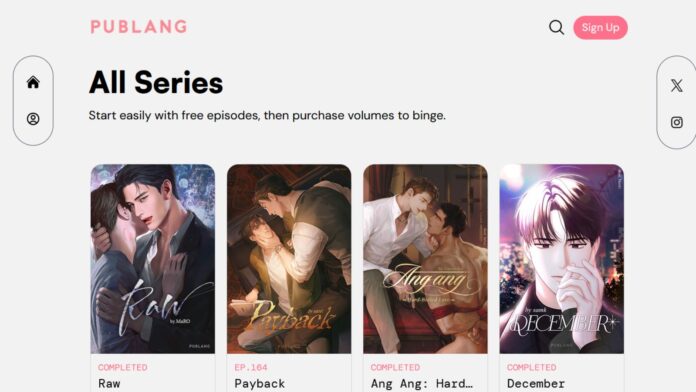
Anime Expo 2026 continues its tradition of educational panels side by side with industry announcements with an increasing variety of talks geared towards fans from all different walks of fandom spaces. Korean BL fans curious for a peek behind the curtain got their tailored taste of the niche with Publang’s “Hyung” He Said: Bringing Korean BL Novels to English panel, headed by managing editor Shauni Kim.
Kim’s panel highlighted Publang’s titles, localization methods, and was a crash course on capturing the nuance of translating Korean to English while still maintaining the integrity of the author’s original intent. After all “A bad translation can sink a title.” stated Kim in her presentation. The process itself is a constant flow of communication between the localization team, translators, and the author themselves as well as a fair amount of research into different cultural norms between countries.
The keyword for the evening was “nuance” as Kim led the talk through her methodology behind certain choices in titles like Marine Code’s Beware the Pup. Readers familiar with the novel did notice that the fan favorite title Paws and Claws wasn’t the final choice for the series. However, with the context of the work being one of prolonged deception on the part of both male leads and with one being an unassuming little dog, Beware the Pup ultimately became the better choice to fit in with the goings-on in the novel.
Honorifics also get taken into consideration when translating and eventually localizing a work. The question of when it’s appropriate to make a text more easily understood by a new audience and when to preserve the original context and culture of a piece requires looking at the overall whole rather than just the parts that potentially need to be changed or omitted. The panel’s titular “hyung”, for example, is one such honorific that informs the relationship between two men that denotes someone younger paying respect to someone older, but still in the same age range, like a brother or a friend.
“Hyung-ah” would be a more childish way to address an older brother figure and is primarily perceived as a cute version of “hyung” used by young children. On the opposite end of the spectrum, there’s “Hyungnim” which implies deep respect and potentially a more formal hierarchy that can add some distance to the relationship. The gangster hierarchy seen in Beware The Ides Of March is a very good example of the usage of “hyungnim” as the more prominent members garner more respect than the general members.
Intention is more prioritized however when it comes to certain things like a particular moment in Beware The Ides Of March. A character reflected on life in the gang as being “just another rat squirming in the gutter”. Kim revealed that the original translation was “just another crab trying to fight his way out of a styrofoam crate”. While the translation isn’t necessarily wrong, it could be difficult for readers unfamiliar with seafood markets or coastal areas to have a good grasp of the imagery or what it implies. The intent behind the author’s wording was taken into consideration instead, the phrasing’s impact establishing the irrelevance of the character’s struggle through life in the same way that his fellows struggled. “Rat” became the more widely understandable choice while still honoring the author’s intention.
This was not the only example of changes that were made. For a certain moment in December, Kim asked the Anime Expo audience about what connotations they thought came with driving a Ford F-150. Predictably, the word “compensating” was offered with no small amount of euphemism. Not only that, but the audience had a lot of questions regarding why an unwieldy American truck like a Ford F-150 was present in a Korean setting where it wasn’t built for the significantly smaller streets.
Kim then asked the audience what they pictured when they thought of luxury vehicles. As expected, answers like Ferrari, Mercedes-Benz, Porsche, and Bugatti were listed. But the question of what Koreans considered luxury was posed and the cultural difference was made very evident. European brands being considered as luxury were a matter of course, but what’s even more difficult to get are American cars unless the buyer had an extreme amount of wealth.
For December, it was important for the vehicle to be American, but also “large and predatory” on the streets. Something that exemplified the character that vehicle belonged to: extremely wealthy, flashy, sleek, and with a vibe of danger. A Ford F-150 was off the table for a Western audience, but with Publang’s communication with December’s author, it was decided that a Range Rover would fit the bill nicely.
While the anecdote was humorous, it was a clear example of the kind of nuances that localization specialists like Kim have to keep in mind. While having footnotes explaining cultural differences is a viable translation tool, the priority should be immediate accessibility. Publang remains conscious of the fact that not all culturally specific differences will be accounted for when being translated. It falls on the shoulders of localization to continuously do research and keep up communication with global resources to ensure that what is being translated is relevant to the reader and accurate to the culture. Even nuances in LGBTQIA+ terminology are thoroughly researched with members of the appropriate community.
“If we don’t know something, we are not arrogant enough not to ask.” Kim stated during the panel.
Publang’s care for ensuring that Korean BL remains linguistically accessible is obvious in their work. Readers can look forward to a range of titles that will showcase the collaborative efforts of the translators and localization team.

