

Japanese digital manga, web novel, and webtoon app, Piccoma, previewed its “ANIME” category which utilizes generative AI to turn select manga works into short form anime. Specifically, AI technology is used as part of the animation production process, while humans handle quality control. The episode previews are currently only available on the app, which is region locked to users in Japan. Its developer, Kakao Piccoma Corp., is a Japanese subsidiary of Kakao Corporation.
Piccoma announced its preview event, where users can share posts about the six adapted webtoon works in order to access the early episodes for free. The first three episodes for each of the six manga and digital comics released on April 27th, and will have weekly episode installments up to the official launch in late May. These short animations are viewable either through its free viewing wait system, similar to the common webtoon model, or it can be accessed by a pay-per-episode rental system.
What alarmed Japanese and Korean netizens is Piccoma’s decision to use AI technology during the creation process. In its press release, the company did not specify at what stages or how AI is being utilized, but the listed animation studios for each series—DAON STUDIO, Yeondam, and GOLEM FACTORY—seem to use it for character movement, backgrounds, and cuts based on the trailer previews posted on YouTube. Although the company is touting the offering as an expansion of its content library—as well as closing the gap between webtoons and animation—online users and manga authors alike have voiced their skepticism on forums and X (formerly Twitter).
Minari Endou, creator of Maria†Holic, weighed in on the situation. She shared how webtoon authors typically have “weak” rights and essentially have no veto power in these kinds of decisions. She adds how webtoon artists use sites and companies that provide 3D assets, such as ACON’s SkecthUP, include terms and conditions which doesn’t allow for redistribution. The license only extends to an individual user or specific work, and Endou brings up this situation might open the company to litigation if the 3D assets are used as AI training material.
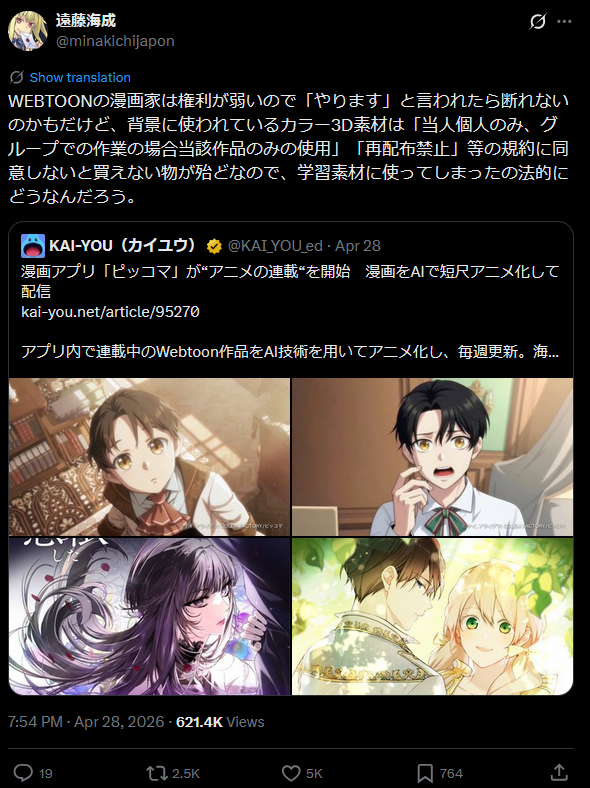
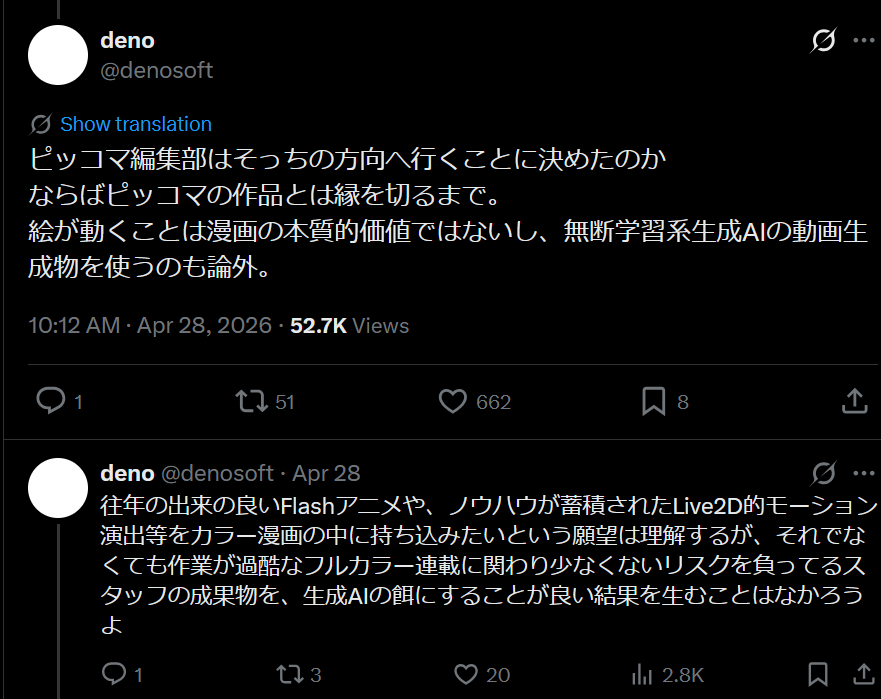
Other anonymous X comments agree and question if the original authors even consented to Piccoma’s decision. Several online users denounced the decision, voicing their decision to “cut ties” with the platform for trampling over the creator’s copyright just to feed into a machine that is “synthesizing stolen goods.” These commenters express that it’s better to never get any kind of anime adaptation at all if an author’s hard work is just fed into generative AI that “rips off copyright and steals like a thief.”
This all comes to light nearly two years after Kakao Piccoma shuttered all its webtoon operations in Europe and focusing its energy on its primary market, Japan. In late 2024, KADOKAWA entered into a business alliance with Piccoma to launch a “MANGA BAR” online manga magazine. It’s unclear if the works serialized in the magazine could potentially become part of these short animations.

