
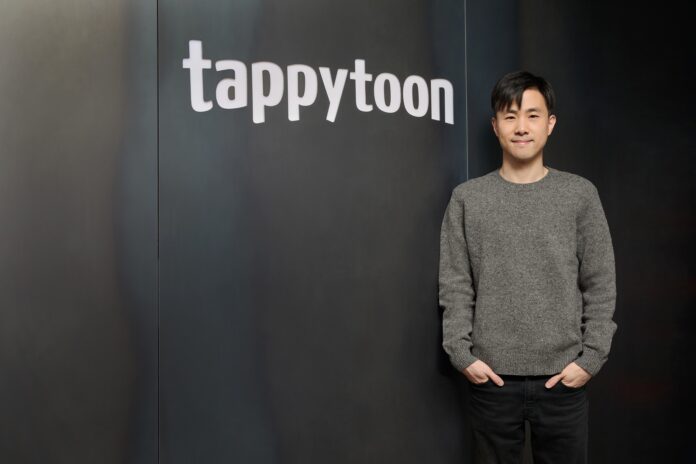
Webtoon platform Tappytoon turns ten years old in 2026. Ernest Woo (Chief Strategy Officer) and Sun Bang founded the platform, which licenses South Korean and other Asian webtoons in English, German, and French, in 2016. In 2021, the platform began integrating webnovels into its offerings and hit seven million registered users in 2022. Now after a decade of development and growth, K-Comics Beat sat down with Woo to speak about Tappytoon’s future as it expands into merchandising and even new format adaptations.
Previously, Woo spoke about appealing to women as they were often underserved by Western comics. Despite the ten years of Tappytoon’s existence, he says the market is still evolving and the challenges remain the same. “Now, everyone has already jumped into digital. A lot of the Japanese publishers like Shueisha, Shonen Jump, and Manga Plaza…have taken up the challenge to kind of spread out their titles.” Even though manga has moved into the digital space, both mediums are competing for eyeballs in the attention economy.
Webtoons itself is no longer a new mode of consumption either, especially as it gained familiarity with the younger generation since the lockdown years. Readers also have changing and maturing tastes as they age. “Audiences expect a certain level of technical craftsmanship. They don’t want just any random story. To maintain and upkeep that level of quality and interest is the challenge for any storytelling medium and industry,” said Woo.
Let’s not forget the genre that drives much of the readership on Tappytoon: Boys Love. Since readers have familiarized themselves and developed a refined taste in the different kinds of stories that Boys Love branches into, I asked Woo how the Tappytoon audience has branched out into other genres. “We started with that slant. We targeted a female readership, because we felt that was the opportunity at the time.” He saw it as an opportunity to take charge since adjacent industry partners hadn’t expanded in that direction yet.
“We made a very big drive a few years ago to also court the male readership by onboarding titles like Solo Leveling. We kicked off our action genre. We specifically tried to move beyond just that definition of our audience, and the female audience naturally were introduced to different types of narratives.” He shared that women and men didn’t only stay within one genre; they move out of their comfort zone and became more curious with story beats. “It’s all about genre blending. That specific kind of wording is no longer that important for a reader, and it’s really the connection to the story and the characters.”
At the same time, the explosive popularity of TV series, Heated Rivalry, shows how mainstream aspects of Boys Love can be seen in the mainstream consciousness. Woo believes it’s an opportunity for publishing and all forms of media. Webtoons and manga draw inspiration from mainstream media and often end up influencing each other. Global sensation, KPop Demon Hunters, is an example of the popularity of Korean culture as it intermixes Western storytelling with pop culture aesthetics. In the digital webtoon space, it almost feels as if Boys Love has touched upon all avenues, from sports to historical drama. “But over time, things change how an audience reacts. Even though we may have had a baseball romance a few years ago, bringing it back now would be a different experience for readers. Trends are helpful.”
On the topic of trends, many American studios seem to be jumping onto the vertical scrolling comic market. As WEBTOON enters into agreements with the Walt Disney Company and Warner Bros. Discovery, is it possible for Tappytoon to eventually head down that path as well? Woo says it’s a good sign for the webtoon industry, especially as he has also spoken with production companies.
“We’re in talks with different industry partners beyond comics, with the most adjacent being games, media like film, video, and TV.” However, he says they must be “more selective” because Tappytoon wants to focus on titles that are “structurally sound” and “have a distinct audience and a distinct fandom that can get excited about them when they change formats.” Although he can’t say if this format will be a TV show or otherwise, talks and meetings are taking place.
While that’s currently in the works, Tappytoon has been looking to expand beyond the digital experience into the real world through merchandise and printed books. Tappytoon entered print publishing with Penguin Random House’s Inklore imprint in 2023. “Penguin Random House approached us for some specific title to be part of the Inklore label. It had a big push from Lore Olympus.” When the new label started, PRH was looking to find titles that were fandom and community driven. The two initial titles that ended up being promoted were The Broken Ring series and Cherry Blossoms After Winter.
Although comics are printed in Korea, it’s to a much smaller degree compared to the American market. “Even if a very popular title is printed, it might be a much smaller print run than a regular textbook. Only a few titles will have a second or third print run here in Korea. Usually that first print run is it.” The smaller run of printed, full color comics make it more like a novelty collectible to super fans rather than one that’s mass market and readily available.
Looking back two decades ago, Korean comics tried to make an impression through print in the American market. “But that was before webtoons, and before they were digital first. Those were also comic books (black and white) that were physical in Korea.” Now, because of the convenience of the digital medium, even Japanese manga titles have expanded move into a vertical or webtoon format, and then put into print, which only shifted in the last four or five years.
Yet merchandise of webtoons is very common in the Korean market. For Tappytoon, the entry into consumer products began as a side project. “We started our merchandise pretty modestly, trying to tie it with the books that were coming out from some of the other publishers that we had deals with.” Due to that built in audience, Tappytoon was looking for ways to further connect with fans, which came from leaning on titles that have a following. “Usually when these publishers in Korea make merch, it stays here. It’s for domestic fans in Korea. We work with them to bring to our international fans.”
Ultimately, the strategy is to both lean on a combination of print books and merchandise to cater to the Tappytoon audience. “We want to have more touch points for our fans, because over the last ten years or so, we’ve been purely digital.” Woo said that they wanted to find a way to connect outside of just the Tappytoon app. “We dabbled with conventions a very long time ago when the platform much smaller. Over the years, we’ve collected enough relationships with fans and partners to make the jump to physical.”
He shared the focus was to encourage fans to spread out of their comfort zones, and transition from their screens to the real world. “When we had a new BL come out from our Tappytoon studio called Bullet Time, we partnered with a newish boy band called New Beat and put out a music video with them using one of their songs.”
So, what is the future of Tappytoon? For now, Woo shared the landscape is still expanding with no clear ceiling in sight. In fact, there’s an even greater and larger audience than ever before. “In the industry, putting out more TV shows, animations, movies, dramas, and such in Korea. But there’s still more things to be done in terms of international productions or even with non-Korean dramas.” He points to the Lore Olympus animated adaptation as a project that’s long been in development and won’t be ready for a couple of years.
Woo also notes the differences in the frequency of webtoon readership between America and Korea as a gap, but a growth opportunity. “Even though, in Korea, webtoons and vertical comics are a daily ritual for about half the population. Not in America. Webtoon readers probably come into the service, depending on which title, maybe once a week.”
To close, Tappytoon remains steadfastly interested in connecting more with fans through different mediums, like merchandise. “Merchandise, for us, was a big jump. I still don’t think any company in the webtoon or digital comics space is doing enough with merchandise compared to how the manga or anime industry is. We’re a lot more behind on that.”

